Observatório Internacional em Colonialismo Digital
O observatório nasceu antes do projeto. Nasceu no campo.
Em 2025, submetemos ao CNPq o projeto Conexões sustentáveis, literacia e soberania digital nas comunidades Mebêngôkre-Kayapó: Observatório Internacional, na chamada PICTI 2025 (Faixa 1, Projeto em Cooperação). A aprovação veio em 2026, com implementação prevista para junho e duração de 24 meses. A iniciativa reúne 17 instituições de cinco países: Brasil, França, Estados Unidos, Portugal e Colômbia.
Mas a origem desse trabalho não está em editais nem em reuniões acadêmicas. Está na experiência acumulada em território.
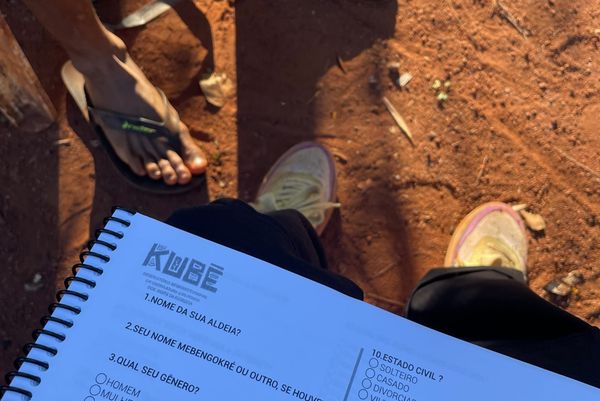
A pesquisa começou em 2020, a partir de um estudo piloto desenvolvido por mim em parceria com a Profa. Dra. Laura C. Zanotti, da University of Cincinnati, e o Prof. Dr. Richard Pace, da Middle Tennessee State University. Naquele momento, acompanhávamos a chegada da internet de alta velocidade às aldeias Mebêngôkre-Kayapó, na Terra Indígena A’Ukre, no Pará, onde eu atuava como a pesquisadora especialista em tecnologia.
Apesar da pandemia, antevimos ali que a digitalização avançava rapidamente, sem consulta prévia, sem protocolos éticos e sem qualquer debate sobre o que aquelas comunidades desejavam, ou não, transformar digitalmente, então, entre 2020 e 2022, estruturamos a base empírica e conceitual que sustentaria o projeto.
Em 2022, convidei a Profa. Dra. Lucia Santaella, da PUC-SP a construir conosco um projeto maior e foi com ela como proponente e executora institucional (pela PUC/SP), que obtivemos o primeiro financiamento de maior monta, aportado pelo CNPq (processo 420933/2022-0, projeto KUBEN), consolidando assim uma nova etapa da pesquisa. Dessa trajetória resultaram o livro Amazônia Digital (Educ, 2024), escrito em coautoria com Santaella, e um conjunto de dados longitudinais construído ao longo de 4 anos, hoje convertido na principal base empírica do observatório.
O que nasce hoje, o Observatório Internacional em Colonialismo Digital parte de uma hipótese simples, mas difícil de ignorar: o que acontece na Amazônia quando tecnologias como a Starlink chegam sem mediação ética não é exceção. É apenas a face mais visível e documentada de um processo que atravessa periferias urbanas, favelas e territórios rurais em diferentes regiões do Sul Global. Estudar os Kayapó, nesse sentido, é também estudar as estruturas contemporâneas de poder digital.
O projeto reúne pesquisadoras e pesquisadores da UFPA, UFMG, UFG, UFBA, UNIFESSPA, EHESS, Sciences Po, Institut Mines-Télécom, ESSEC, University of Cincinnati, Middle Tennessee State University, MAST (Rio de Janeiro) e Universidad Jorge Tadeo Lozano, entre outras instituições.
Assumo a vice-coordenação e sou a responsável pela estratégia de internacionalização da rede. Este é um projeto que nasceu de minhas mãos, mas que foi construído em um patchwork de talentos e compromissos éticos com o apoio de grandes pesquisadores como Lucia Santaella (coordenadora e proponente); Winfied Noth; Laura Zanotti; Richard Pace; André Lemos, Geane Alzamora, entre muitos outros de igual talento e comprometimento.
Entre os principais objetivos estão o mapeamento crítico das infraestruturas de conectividade amazônicas, o desenvolvimento de metodologias interculturais de literacia digital construídas com as comunidades, a produção de conhecimento decolonial sobre soberania informacional e a formulação de recomendações de governança tecnológica voltadas a diferentes contextos do Sul Global.
Parte dessa diferença está na mobilidade internacional prevista pelo projeto. Estão previstas bolsas de formação para pesquisadores indígenas, especialmente mestrandos e doutorandos em formação, com missões acadêmicas de um a três meses em instituições parceiras na França, nos Estados Unidos e em Portugal. Não se trata apenas de circulação acadêmica. Trata-se de deslocamento epistemológico.
Hoje, grande parte do debate global sobre colonialismo digital, soberania de dados e ética da inteligência artificial continua sendo conduzida sem a presença efetiva daqueles que vivem, em seus próprios territórios, os efeitos mais concretos desses processos. Povos indígenas seguem sendo frequentemente tratados como fonte de dados, campo empírico ou objeto analítico. O projeto parte de outra posição: pesquisadores indígenas são produtores de conhecimento, formuladores de teoria e interlocutores centrais de qualquer discussão sobre digitalização em territórios tradicionais.
Quando uma pesquisadora indígena apresenta sua pesquisa fora do Sul Global o que está em jogo não é representatividade simbólica. É uma reorganização, ainda que parcial, das posições históricas de autoridade no campo científico. Durante muito tempo, comunidades indígenas apareceram apenas como aquilo que era descrito. A possibilidade de ocupar o lugar de enunciação altera não apenas quem fala, mas também o que pode ser pensado.
O projeto reúne pesquisadores de diferentes etnias indígenas, e não apenas Mebêngôkre-Kayapó. O ponto de partida é amazônico, mas o problema é mais amplo. Em diferentes regiões do Sul Global, comunidades inteiras atravessam processos acelerados de digitalização sem participação real sobre os termos dessa transformação. Existe aí um conhecimento situado que os modelos convencionais de pesquisa ainda têm dificuldade de reconhecer e escutar.
Por isso, neste projeto, a mobilidade indígena não aparece como dimensão complementar da pesquisa. Ela faz parte da própria estrutura de produção do conhecimento.
O observatório já está disponível online, em português, francês, inglês e espanhol, no endereço amazoniadigital.org.
Mais do que uma aprovação institucional, este projeto representa o amadurecimento de uma pesquisa construída a partir da escuta, da permanência em campo e de relações desenvolvidas ao longo de seis anos. O centro de tudo continua sendo o território. E é para ele que o conhecimento produzido precisa retornar.
International Observatory on Digital Colonialism
In 2025, we submitted to CNPq the project Sustainable Connections, Digital Literacy and Digital Sovereignty in Mebêngôkre-Kayapó Communities: International Observatory, under the PICTI 2025 call (Track 1, Cooperative Project). Approval came in 2026, with implementation scheduled for June and a duration of 24 months. The initiative brings together 17 institutions from five countries: Brazil, France, the United States, Portugal, and Colombia.
But the origin of this work does not lie in funding calls or academic meetings. It lies in accumulated experience in the territory itself.
The research began in 2020 through a pilot study developed by me in partnership with Prof. Dr. Laura C. Zanotti, from the University of Cincinnati, and Prof. Dr. Richard Pace, from Middle Tennessee State University. At that time, we were following the arrival of high-speed internet in the Mebêngôkre-Kayapó villages within the A’Ukre Indigenous Territory, in Pará, where I worked as the researcher specialized in technology.
Despite the pandemic, we could already foresee that digitalization was advancing rapidly, without prior consultation, without ethical protocols, and without any meaningful debate about what those communities did—or did not—wish to transform digitally. Between 2020 and 2022, we therefore structured the empirical and conceptual foundations that would later sustain the project.
In 2022, I invited Prof. Dr. Lucia Santaella, from PUC-SP, to build a larger project with us. With her as principal investigator and institutional lead through PUC-SP, we obtained the first major funding support from CNPq (Process 420933/2022-0, KUBEN Project), consolidating a new phase of the research. From this trajectory emerged the book Digital Amazon (Educ, 2024), co-authored with Santaella, as well as a longitudinal dataset built over four years, now constituting the observatory’s main empirical foundation.
What emerges today as the International Observatory on Digital Colonialism starts from a simple yet difficult-to-ignore hypothesis: what happens in the Amazon when technologies such as Starlink arrive without ethical mediation is not an exception. It is merely the most visible and documented face of a process unfolding across urban peripheries, favelas, and rural territories throughout different regions of the Global South. Studying the Kayapó, in this sense, also means studying the contemporary structures of digital power.
The project brings together researchers from UFPA, UFMG, UFG, UFBA, UNIFESSPA, EHESS, Sciences Po, Institut Mines-Télécom, ESSEC, the University of Cincinnati, Middle Tennessee State University, MAST (Rio de Janeiro), and Universidad Jorge Tadeo Lozano, among other institutions.
I serve as vice-coordinator and lead the network’s internationalization strategy. This is a project born from my own hands, but built through a patchwork of talents and ethical commitments, with the support of major scholars such as Lucia Santaella (coordinator and principal investigator), Winfried Nöth, Laura Zanotti, Richard Pace, André Lemos, Geane Alzamora, and many others of equal talent and commitment.
Among the project’s main objectives are the critical mapping of Amazonian connectivity infrastructures, the development of intercultural digital literacy methodologies built alongside the communities, the production of decolonial knowledge on informational sovereignty, and the formulation of technological governance recommendations aimed at different contexts within the Global South.
Part of this distinction lies in the project’s international mobility strategy. Training fellowships are planned for Indigenous researchers, especially master’s and doctoral students in formation, including academic missions lasting from one to three months in partner institutions in France, the United States, and Portugal. This is not merely academic circulation. It is an epistemological displacement.
Today, much of the global debate on digital colonialism, data sovereignty, and AI ethics continues to be conducted without the effective presence of those who experience, within their own territories, the most concrete effects of these processes. Indigenous peoples are still frequently treated as data sources, empirical fields, or analytical objects. This project starts from another position: Indigenous researchers are producers of knowledge, formulators of theory, and central interlocutors in any discussion about digitalization in traditional territories.
When an Indigenous researcher presents her work outside the Global South, what is at stake is not symbolic representation. It is a reorganization—even if partial—of the historical positions of authority within the scientific field. For a long time, Indigenous communities appeared only as those being described. The possibility of occupying the position of enunciation changes not only who speaks, but also what can be thought.
The project brings together researchers from different Indigenous ethnic groups, and not only Mebêngôkre-Kayapó communities. The starting point is Amazonian, but the issue is broader. Across different regions of the Global South, entire communities are undergoing accelerated processes of digitalization without any real participation in defining the terms of that transformation. There is situated knowledge there that conventional research models still struggle to recognize and listen to.
For this reason, Indigenous mobility does not appear in this project as a complementary dimension of the research. It is part of the very structure of knowledge production itself.
The observatory is already available online, in Portuguese, French, English, and Spanish, at amazoniadigital.org.
More than an institutional approval, this project represents the maturation of a research trajectory built through listening, permanence in the field, and relationships developed over six years. At the center of everything remains the territory. And it is to the territory that the knowledge produced must ultimately return.
Dr. Kalynka Cruz
May 2026
Amazonia Digital Research Group · CNPq nº 789828 · FACOM/PPGCom · UFPA